
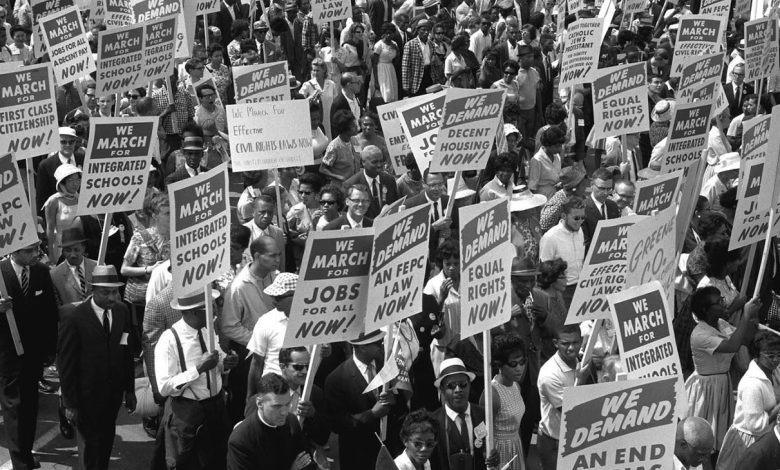
Remembering the March on Washington for Jobs and Freedom

By Jennifer Levasseur, Vickie Lindsey, and Amy Stamm
Forty years ago, on Aug. 30, 1983, Guy Bluford flew into history as the first Black American in space.
Despite launch delays totaling six weeks, the spectacular first night launch of a Space Shuttle brought full circle NASA’s promise of a more inclusive astronaut corps.
Following Sally Ride (America’s first female astronaut) by just two months, Bluford’s spaceflight aboard Space Shuttle Challenger provided another visible moment when more young people could see and be inspired by people like themselves flying into space.
Bluford served as a mission specialist on the STS-8 mission and his jobs were to deploy an Indian communications-weather satellite, perform biomedical experiments and test the orbiter’s 50-foot robotic arm.
Following that first mission, he flew three more times to space on STS-61A, STS-39, and STS-53. By the time of his retirement from NASA in 1993, Bluford had spent more than 28 days in space over the four missions.
At the time of his first mission, Bluford was a 40-year-old Air Force officer with a doctorate in aerospace engineering.
Reluctant to be in the spotlight, his goal was not to make history, but fly into space, do his job, and return safely.
Growing up in a middle-class household in the 1950s and 1960s with educated parents (his mother was a teacher, and his father was a mechanical engineer), Bluford was raised to believe that he could do anything he wanted despite racist social restrictions.
He enjoyed math and science, particularly in school. Ignoring the advice of his high school advisor to learn a trade or skill, Bluford went on to college to earn his undergraduate degree in aerospace engineering at Penn State University in 1964, also finishing as a distinguished Air Force ROTC graduate.
After his decades of service to the aerospace community in a variety of roles, having spoken dozens of times about his astronaut career and work in aviation, Dr. Guion Bluford was recently appointed by President Joseph Biden as a member of the Smithsonian National Air and Space Museum’s Advisory Board.
Editor’s note: Jennifer Levasseur, Vickie Lindsey and Amy Stamm are writers for a NASA blog
This post was originally published on this site
